Couscous: The Friday Dish of Morocco
If you are in Morocco on a Friday around noon, you will smell the dish before you see it: steam, meat broth, and turmeric drifting out of apartment stairwells and restaurant kitchens. In Fes, Marrakech, and every village between them, Friday is couscous day. This is the meal that empties offices at midday, pulls families back to the same table once a week, and, for a traveler, is the single most Moroccan lunch you can have. Here is what couscous really is, why Friday belongs to it, and how to eat it the way Moroccans do.
What couscous actually is
Start with the basics, because the name confuses many visitors. Couscous is both the grain and the finished dish. The grain itself is tiny granules of rolled durum wheat semolina, made by wetting semolina flour and rolling it by hand in a wide, shallow tray until it forms small pellets. Those pellets are then steamed, not boiled. The finished dish is the steamed grain served on a large communal platter, topped with vegetables, meat, and broth.
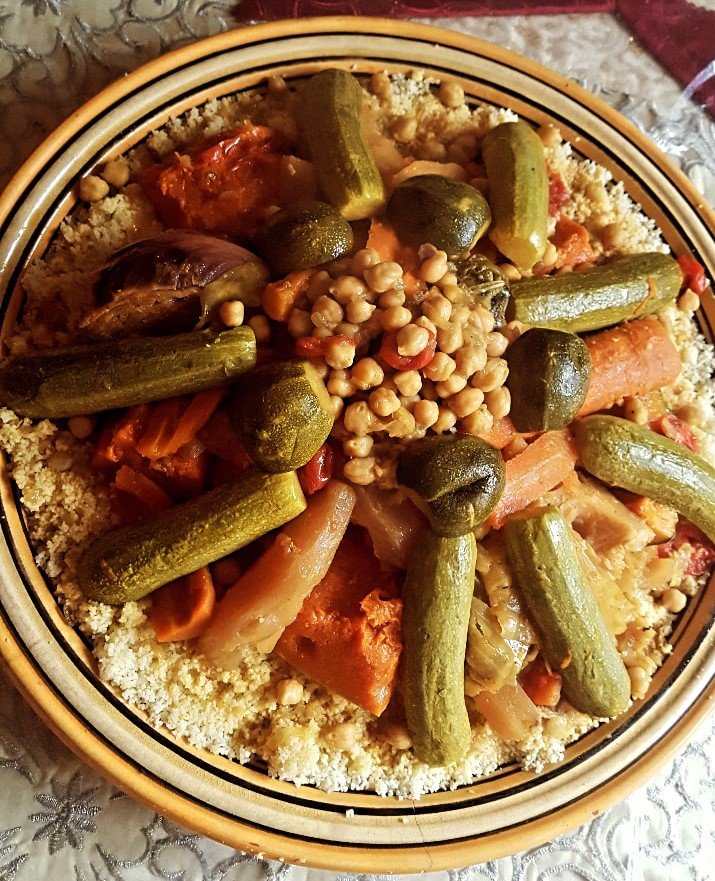
The word comes from Tamazight, the language of the Imazighen (Berbers), the indigenous peoples of North Africa, where the dish was born. In December 2020, UNESCO inscribed the knowledge and practices of couscous production and consumption on its Intangible Cultural Heritage list, through a joint nomination by Algeria, Mauritania, Morocco, and Tunisia. In Morocco, the Friday version you will be served most often is couscous aux sept légumes, couscous with seven vegetables: carrots, zucchini, pumpkin, cabbage, turnip, tomato, and chickpeas, piled over the grain with pieces of lamb, beef, or chicken underneath.
How real couscous is made
The difference between couscous worth remembering and the bland grains from a supermarket box is the steaming. Real couscous is made in a couscoussier, a two-tiered pot: the stew bubbles in the bottom while the semolina granules steam above it in a perforated top tier, absorbing the broth’s flavor as it cooks. The grain is steamed not once but in stages, with the cook pulling it out between rounds to break up lumps, fluff the granules, and sprinkle them with water or broth. Only this repeated steaming and hand-fluffing produces the light, separate grains Moroccans judge a good couscous by — grains that hold their shape and never turn mushy.

Making it takes hours. A home cook starts the meat and vegetable broth early in the morning, and steams the grain while the broth develops. That slow, hours-long preparation is exactly why it became a Friday dish: a celebratory meal made when the family is actually together. The practical takeaway for you as a traveler: if a restaurant serves you couscous that arrives suspiciously fast on a random Tuesday evening, it was almost certainly not made the slow way.
Why Friday belongs to couscous
Friday is Jumu’ah, the day of the congregational midday prayer in Islam, and the weekly rhythm of Morocco is built around it. After the prayer, families gather for the biggest meal of the week, and that meal is couscous. The connection is social as much as religious: one enormous platter in the center of the table, everyone eating from the same dish, often with the hands replacing spoons for the grain.

Travelers can take direct advantage of this. In traditional restaurants in the medinas of Marrakech, Fes, and Meknes, Friday lunch is when couscous is made fresh and served in full ceremony. Many smaller eateries only offer it on Fridays at all, so Friday is your guaranteed window for the real thing. Eat it at midday, the way locals do, and you will often find it served with a glass of lben (soured milk) or followed by sweet mint tea — both cut through the richness of the broth beautifully.
📸 Worth capturing yourself: this is the spot for a photo of a real Friday couscous spread — the full family-style platter you ate from.
Couscous varieties to know
Moroccans do not mean one single recipe when they say couscous. These are the three versions a traveler is most likely to meet, and each has its own logic:
Couscous aux sept légumes

The national classic and the standard Friday plate. Seven vegetables — typically carrot, zucchini, pumpkin, cabbage, turnip, and tomato, plus chickpeas — simmered in a spiced broth with lamb or beef, then arranged over a mountain of steamed grain. The broth is ladled on at the table. If a menu simply says “couscous” with no qualifier, this is almost always what arrives. It is the benchmark: once you have had a good seven-vegetable couscous, you have a reference point for everything else.
Couscous tfaya

The sweet-savory one, and a Friday favorite in its own right, especially around Marrakech. Tfaya is a topping of slowly caramelized onions cooked down with raisins, chickpeas, cinnamon, and sugar until it turns jammy and dark. It is spooned over the couscous in a wide circle, often with toasted almonds scattered on top, over lamb or chicken. The first bite surprises first-timers — sweet onion jam over steamed grain — but the cinnamon and meat broth underneath balance it into something deeply savory. If you see “couscous tfaya” on a Friday menu, order it.
Seffa

The sweet one, and the oddity of the family: steamed couscous (or sometimes fine vermicelli) served as a dessert-style dish with powdered sugar, cinnamon, and toasted almonds, occasionally with raisins. Seffa shows up at weddings, Eid celebrations, and family feasts rather than on ordinary Fridays, which is why many travelers never encounter it. We will give it a full article of its own soon; for now, know that if a host sets down a mound of sweet, sugar-dusted couscous, it is a festive dish, not a failed savory one.
Couscous changes with the map
The basic technique is national, but the topping follows the geography. In the north, along the coast near Tetouan and around Essaouira, some cooks make the Friday dish with fish instead of meat — the same steamed grain, but the broth comes from the sea, and it is a world away from the meat versions inland. In the High Atlas mountains, the dish runs heartier: more root vegetables, beef rather than lamb, and often smen (aged, fermented butter) stirred in, which gives the broth a deep, pungent character mountain cooks prize. Further south, in the Souss and the pre-Saharan valleys, couscous is sometimes rolled from barley instead of wheat, a legacy of what the land actually grows. None of these replace the Friday seven-vegetable standard, but knowing they exist means you will not mistake a regional specialty for a mistake.
Where to eat couscous as a traveler
The honest answer is: Friday lunch, in a family-style restaurant, in or near the medina. Look for the places where the couscoussier is actually steaming when you walk in — many traditional kitchens do the steaming visible from the entrance or the terrace. Tourist-oriented restaurants in Marrakech and Fes serve couscous daily, but the Friday batch is when the kitchen gives it its full attention, so plan your week so your couscous day falls on a Friday.
Practical points that save disappointment. Couscous is a lunch dish in Moroccan culture; ordering it at 9 p.m. is possible in tourist areas but culturally off-key, like ordering a full Sunday roast at midnight back home. It arrives on one platter for the table — if you are two people, one order is usually enough to share. And a plate that costs only a few dirhams at a workers’ canteen is not the same product as the ceremonial Friday platter; for budget planning on food costs in general, our guide to food prices in Morocco in 2026 lays out what meals actually cost.
📸 Worth capturing yourself: your own photo of a medina restaurant couscous platter fits perfectly here.
Mistakes travelers make with couscous
- Expecting it every day. In homes, couscous is a Friday (and feast-day) dish. Eating it on Friday is participating in the ritual; eating it on Wednesday in a hotel is just eating dinner.
- Expecting it spicy. Moroccan couscous is aromatic, not hot. The flavor comes from ginger, turmeric, saffron, cinnamon, and cumin in the broth — there is no chili heat by default. If you want heat, ask for harissa on the side, the way northern diners do.
- Comparing it to box couscous. Instant couscous is pre-steamed and rehydrated. The grain in a proper Friday couscous has been steamed two or three times and hand-fluffed between rounds. The texture difference — separate, light grains versus a clump — is the whole story.
- Skipping the broth. The cook ladles broth over the mound at serving, but a good table always has more broth on the side. Dry couscous is a missed opportunity; spoon the extra broth over your portion generously.
Frequently asked questions
Is couscous eaten every day in Morocco?
No. In Moroccan homes it is the Friday dish, plus weddings, Eid, and celebrations. Restaurants in tourist areas serve it daily, but the authentic weekly rhythm is Friday lunch after the midday prayer.
What exactly is tfaya?
Tfaya is the sweet-savory topping on couscous tfaya: onions caramelized slowly with raisins, chickpeas, cinnamon, and sugar, finished with toasted almonds. It is especially associated with the Marrakech region and Friday tables.
Is there a vegetarian couscous?
Easily. The seven-vegetable version without meat is common — the vegetables and chickpeas simmer in the same spiced broth, and many families make a meatless Friday couscous. Just say “couscous aux légumes, sans viande” when ordering.
Is couscous gluten-free?
No. Traditional couscous is made from durum wheat semolina, so it contains gluten. Travelers with celiac disease should treat it as strictly off-limits, since even the steaming equipment is shared with wheat.
What should I drink with couscous?
Mint tea is the classic finish, and many families serve lben (soured milk) alongside the platter. Water is perfectly fine too — the dish is rich, and you will want something to cut through the broth.
If couscous was your entry point into Moroccan cooking, the natural next step is the other great slow-cooked dish: our complete guide to Moroccan tagine. And if you want to see where Moroccans eat after dark, our Moroccan street food guide and the night food scene at Jemaa el-Fna pick up where the Friday lunch leaves off.
Photos: “Couscous aux sept légumes” by Solima Arizo (CC BY-SA 4.0), “Couscous — typical Moroccan Friday lunch” by Weirdnibbles (CC BY-SA 4.0), “Moroccan couscous of tfaya” by Samarrows (CC BY-SA 4.0), “Moroccan seffa” by Houssain Tork (CC BY-SA 4.0), “Couscoussier” by Catskingloves (CC BY-SA 3.0) — all via Wikimedia Commons.
Recipe: Couscous with Seven Vegetables
Friday’s dish, done the proper way: fluffy hand-rolled grains, melting vegetables, and a rich broth served on the side. The triple steaming is what separates real couscous from the instant kind.
Ingredients (serves 6–8)
- 500 g medium-grain couscous
- 500 g beef or lamb, cut into large chunks
- 2 onions — 1 chopped, 1 quartered
- 2 tomatoes, grated
- 2 carrots, peeled and halved
- 2 zucchini, halved
- 1 small pumpkin wedge (about 300 g)
- 1 turnip, quartered
- 1/4 white cabbage
- 150 g dried chickpeas, soaked overnight
- 2 tablespoons tomato paste
- 1 tablespoon ras el hanout (or 1 teaspoon each ginger, turmeric and black pepper)
- 50 g butter or smen
- 4 tablespoons olive oil
- Salt to taste
Preparation
- In the bottom of a couscoussier (or a large pot), brown the meat in olive oil with the chopped onion, spices and tomato paste. Add 1.5 litres of water, the chickpeas and salt. Simmer 30 minutes.
- Add the carrots, turnip, cabbage and quartered onion. Simmer 20 minutes, then add the zucchini, pumpkin and grated tomato. Simmer about 25 minutes more, until everything is tender.
- Meanwhile, put the couscous in a wide bowl. Sprinkle with about 250 ml of salted water, toss, and let it absorb for 10 minutes. Transfer to the steamer basket and steam 20 minutes.
- Tip the couscous back into the bowl, sprinkle with a little more water, break up any lumps with your fingers, work in half the butter, and steam a second time for 20 minutes. Repeat once more — three steamings in total.
- Mound the couscous on a large platter, work in the remaining butter until glossy, arrange the meat and vegetables on top, and serve the broth in a separate bowl for each guest to moisten their portion.
Tip: the triple steaming is non-negotiable — it is what makes the grains light and separate instead of mushy.