Where to Eat in Marrakech: A Food Lover’s Guide
Marrakech is not one food city but several, stacked within a short taxi ride. The medina eats one way — charcoal smoke, communal ovens, tea poured from a height — and Guéliz eats another, over wine lists and café terraces. The trick is not finding the single best restaurant. It is knowing which neighborhood to be in at which hour, and what each one does better than anywhere else.
Start with the map: five eating zones
Before you pick restaurants, learn the geography: the same dish can cost twice as much and taste half as good on the wrong side of the city.
- The Medina — the old walled city around Jemaa el-Fna square: night stalls, morning grill rows, souk food, and rooftop restaurants hidden behind unmarked doors.
- The Mellah and souk quarters — working-food neighborhoods: lunch counters, bread ovens, and vendors who have served the same street for decades.
- Guéliz — the French-built “new city” west of the medina: modern restaurants, café-brasseries, and the city’s best licensed dining.
- Hivernage and the Palmeraie — the hotel zone: upscale hotel restaurants and long out-of-town lunches, best treated as planned excursions.
- Rooftops — not a neighborhood but a format: Marrakech’s signature way of having dinner, scattered across the medina.
The Medina and Jemaa el-Fna: the night kitchen
At dusk, Jemaa el-Fna fills from nothing: hundreds of numbered stalls roll in, white smoke rises, and the center of the square becomes the largest open-air food court in North Africa. Men stationed outside each awning will try hard to pull you in — a polite, repeated “no” is the complete vocabulary you need.
Here is how to work the system. The stalls compete on volume, so quality varies a great deal between awnings. The specialists are the exception: the carts ladling snail broth and the grills doing nothing but skewers and sausages are the best food on the square. The rule that works: sit where the locals sit. A long line of Moroccans at 9 p.m. is worth more than any review.
The night stalls are a spectacle you should see once, but plan on eating lightly there. For the deeper version of the square’s food, read our full guide to eating at the Jemaa el-Fna night food stalls before you go.
Mechoui Alley: the morning meal people remember
The best food within walking distance of the square is not at night at all. Just off the northern edge, a short row of shopfronts — known to everyone as Mechoui Alley — roasts whole lambs overnight in clay pits under the floor. Go at lunchtime, because when the lamb is gone the day is over, usually by early afternoon. It is cash only, you point at what you want, and it is weighed and served with bread, cumin, and salt.
The cut matters: ask for shoulder rather than leg, because the fattier shoulder is better. Chez Lamine, in the medina near the square, is the established name for the same format — slow-roasted lamb and tangia cooked the traditional way (name confirmed from a September 2026 restaurant roundup).
Guéliz: where the city eats when it wants a proper meal
Cross to Guéliz and the register changes completely. This French-planned district of wide boulevards is where Marrakech keeps its serious kitchens, its wine lists, and its lunch tables full of locals rather than tour groups.
Two addresses are worth planning around. Al Fassia has been run and staffed entirely by women since the late 1980s, serving precise Fassi cooking — and unlike much of the medina it is licensed, so a bottle of Moroccan red is possible (restaurant guide updated late September 2026). Amal Centre is the other: a non-profit training disadvantaged women in professional cooking, serving simple daily-changing Moroccan home food at a fraction of medina prices. Go at noon — it stops serving early and does not do dinner.
For the café side of Guéliz, the Grand Café de la Poste has anchored the district since the 1920s, a colonial-era brasserie with verandas made for a long alfresco lunch. And Bacha Coffee, inside the restored Dar el Bacha palace in the medina, turns coffee into a midday ceremony: an extraordinary list of single-origin coffees in one of the most beautiful buildings in the city.
Guéliz is also the answer to the question every group asks around night four of a trip: “can we have a salad and a steak?” The newer kitchens here do Moroccan produce with a lighter modern hand. Plan for that night rather than resisting it.
Rooftops: dinner with the Koutoubia in view
The rooftop restaurant is Marrakech’s signature dining format: terraces above the souks with the Koutoubia minaret and the Atlas in the frame. Rooftops like Nomad and Terrasse des Épices in the souk quarter pair that view with lighter modern Moroccan cooking — salads, grills, vegetable-forward plates that counterweight days of heavy tagines. Le Jardin is the day-to-night version: coffee by day, candlelit by night.
Two practical notes. First, reserve ahead for the famous ones. Second: many medina rooftops do not serve alcohol at all, while Guéliz restaurants and grand hotel dining rooms do. Assume nothing, and mention it when you book if it matters to your group.
The Mellah, the souks, and the food between meals
The best eating hour in the medina is not dinner — it is the morning, on foot. Walk any residential lane and you will find the counters where the neighborhood eats: vendors frying morning doughnuts, ladling soup from cauldrons at dawn, grill smoke starting before the shops open. The communal bread ovens, the ferrane, where families drop off their shaped dough each morning to be baked and collected, are still part of daily life.
The souks around the spice square (Place des Épices) are dotted with small food stalls between the shops, and the old Mellah quarter to the southeast keeps the same lunch-counter rhythm at lower prices than the square. Grazing territory: eat small, eat often, keep moving. Bring cash and an appetite.
What to eat where: the five dishes that define Marrakech

Tangia — the city’s own dish
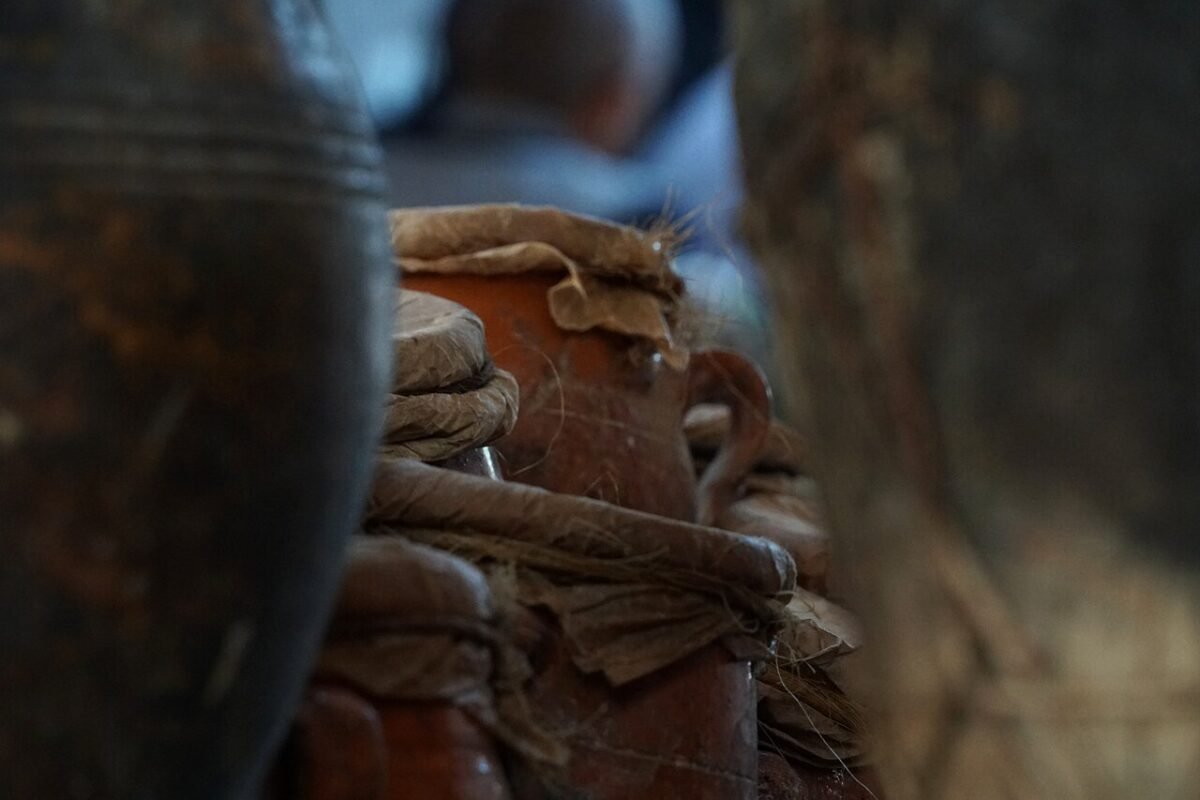
Meat, preserved lemon, garlic, smen (aged butter), cumin, and saffron go into a tall clay urn; the urn is sealed and carried to the furnatchi, the man who tends the furnace heating the neighborhood hammam, where it sits in the ashes for hours. Traditionally a bachelor’s dish, made by men rather than in the family kitchen.
The crucial detail: it cannot be made to order. A kitchen has to commit in the morning, so ask your riad or a serious restaurant a day ahead — that is the difference between the real thing and a hurried imitation. For the full story of the stalls, see our Moroccan street food guide.

Méchoui — lamb from the pit
Whole lamb, roasted overnight in a clay pit until the meat falls off the bone, sold by weight from shopfronts like the ones at Mechoui Alley. Eat it the local way: torn pieces on bread with cumin and salt, standing up, at midday. Nothing about this dish needs a white tablecloth.

Pastilla — the sweet-savory test of a kitchen
Layers of crisp warqa pastry wrapped around shredded poultry, almonds, egg, and spices, dusted with powdered sugar and cinnamon. When a kitchen gets pastilla right — shattering crust, balanced sweetness — everything else on its menu is trustworthy. The classic Marrakech version uses chicken or pigeon; Al Fassia’s is the version other kitchens get measured against.

Harira — the soup that opens the evening
Tomato, lentils, chickpeas, and onion, thickened and served steaming. Harira is the soup of Ramadan evenings, but in Marrakech it is a dawn-to-night staple — the Jemaa el-Fna stalls ladle it by the bowlful, and the dawn soup counters are where working Marrakech starts the day. A bowl costs a few dirhams.

Babbouche — the snail soup locals actually eat
The most local dish on the square, and the one most visitors walk past: snails simmered in a fragrant broth of aniseed, licorice root, and thyme, served steaming from a giant pot. It costs very little, it is the thing Marrakchis order without thinking, and it is the bowl travelers later wish they had tried.
The practical playbook: times, prices, and tourist traps
Best times. Breakfast counters peak before 10 a.m. Mechoui Alley is a midday affair, finished by early afternoon. Guéliz lunch runs noon to 2 p.m. The Jemaa el-Fna stalls hit their stride after 8 p.m. Rooftop dinners need reservations on weekends. The out-of-town lunches (Palmeraie, Route du Barrage) and Agafay desert dinners deserve their own half-day — book in advance. For a sense of how restaurant formats and prices compare across the city, our guide to Moroccan restaurant types breaks down what each format costs and what to expect.
Tourist-trap warning signs. A menu printed in four languages, a tout stationed at the door, and a courtyard that seats eighty. None is fatal on its own — all three together is a reliable warning. The riad-set-menu circuit (same soup, same tagine, same sweet orange dessert everywhere) is not bad food, but it is produced at scale for short stays, not Moroccan home cooking.
Money. The medina runs on cash: stalls, counters, and Mechoui Alley do not take cards. Agree on a price before you sit when one is quoted — haggling belongs in the souks, not restaurants. For concrete numbers by format, see our food prices in Morocco guide.
📸 A photo of your own spread at a rooftop dinner or a mechoui lunch would close this guide with a personal touch.
FAQ
Which neighborhood should I stay in for the food?
The medina near Jemaa el-Fna: the night stalls, Mechoui Alley, souk rooftops, and morning counters are all walkable. Choose Guéliz if you prefer modern restaurants and licensed dining at your doorstep.
Is the street food in Marrakech safe to eat?
Mostly, with the usual care. Eat what is cooked in front of you rather than what is sitting in a warm tray, be more careful late at night than at lunchtime, and prefer grilled meat to raw salads. The dawn soup counters and lamb pits have very high turnover — the best protection there is.
Where can I get real tangia?
Real tangia takes hours in the hammam furnace ashes and cannot be made to order — ask your riad or a serious restaurant at least a day ahead. Chez Lamine near the square is the established medina name for tangia and méchoui.
Can I drink alcohol with dinner?
Many medina restaurants do not serve it; licensed dining concentrates in Guéliz restaurants, riads, and hotel dining rooms. Check in advance and say so when you book if it matters to your group.
Photos: Adam Harangozó (CC BY-SA 4.0), Andre Piquet (CC BY 3.0), Miznate (CC BY-SA 4.0), Miansari66 (CC0), and Elgaard (CC BY-SA 4.0) via Wikimedia Commons.