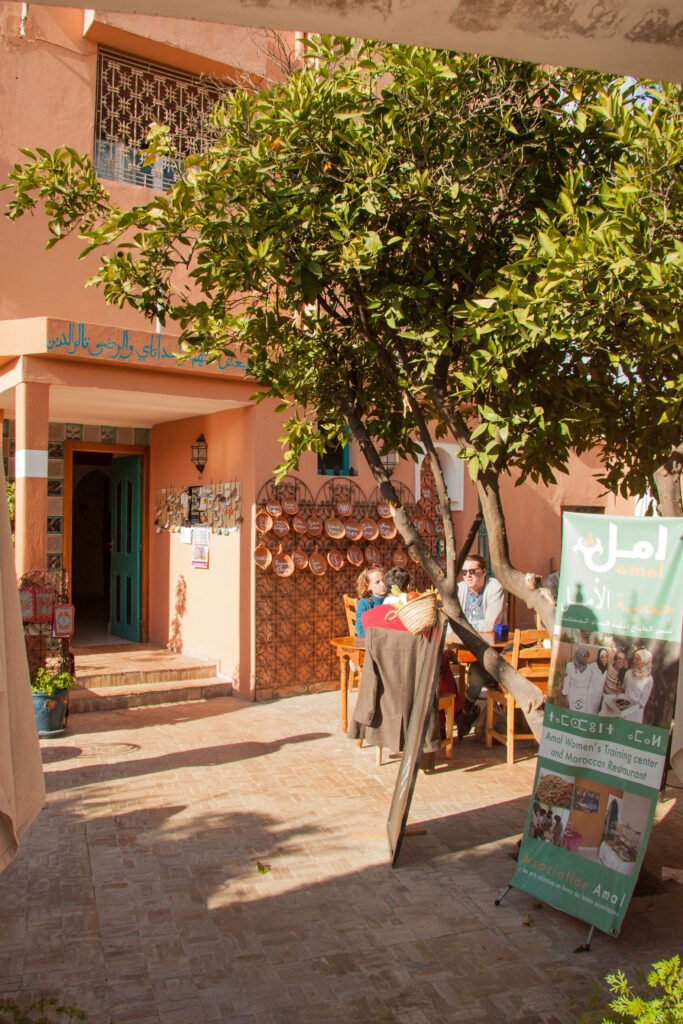

Morocco runs on food hospitality. A shopkeeper will offer you tea before you have finished your sentence, and a cook at a grill will cut you a taste of what is on the fire without being asked. That generosity is real — which is why the few restaurants built to extract money from visitors feel so jarring when you hit one. A tourist-trap restaurant in Morocco is not a scam in the classic sense: you will get edible food. What you get instead is a watered-down menu, prices two to three times what locals pay, and a meal that teaches you nothing about Moroccan cooking. The difference between the two experiences is not luck. It is a set of signs you can learn to read in about ten minutes, and this guide teaches you to read them.
The rabatteur at the door
The single strongest signal costs you nothing to observe. If a young man is standing in the street, outside the menu board, pulling at passersby with eye contact, compliments, or a hand on the shoulder — “mon ami, best tagine, come see” — you are looking at a restaurant that cannot fill its tables on reputation. Good restaurants in Morocco are full, noisy, and indifferent to whether you walk in. The rabatteur (the tout) exists to intercept you before you reach a better option.
The counter-move: never eat where you had to be talked into it. Walk two streets over and sit down where nobody is selling — this alone eliminates most bad meals in Marrakech, Fes, and Chefchaouen.
The menu test: no prices, no trust
A real menu in Morocco has prices printed next to every dish, in dirhams. That is the law and the custom. A tourist trap will do one of three things instead: show you a menu with no prices at all, show a menu where the prices are covered or “being updated,” or quote you prices verbally that feel like they were invented for your face. If you cannot read a price before you sit down, walk away.
Verbal quoting is how the square works at night — stall prices are often agreed on the spot — but a sit-down restaurant with printed food and no printed prices is a choice, not a tradition. Ask “ch’hal?” (how much?) for anything unpriced — a nervous answer is an answer.
Laminated photo menus in six languages
The laminated menu with glossy photos — tagine, couscous, pizza, spaghetti, pancakes — translated into English, French, Spanish, German, Italian, and Chinese is the universal flag of a kitchen cooking for everyone and for no one. A laminated photo menu is aimed at tour groups who decide in thirty seconds from the sidewalk.
Real Moroccan menus are often handwritten on a whiteboard, or a single printed page in French and Arabic. The whiteboard matters: it changes daily, which means the kitchen buys what is fresh that morning. A menu that never changes and never runs out of anything is a menu built from a freezer.
The location test: front row versus side street

On Jemaa el-Fna in Marrakech, the stalls and terraces with the best view of the square pay the highest rent — and the kitchen quality drops in exact proportion to how good the view is. The front-row terraces serve food as the price of a seat. The stalls one or two streets back, behind the mosque, serve food because that is the business.
This is not only Marrakech. In any Moroccan city, a restaurant on the main tourist artery — the square in front of the Hassan II Mosque in Casablanca, the Blue Gate square in Fes — charges you for the address. Walk five minutes in any direction, and the same chicken tagine appears for roughly half the price, cooked better, served faster. The test: if you can see the landmark from your table, you are paying the landmark tax. Take the mint tea for the view; eat properly somewhere else.
The bread-and-olives trick
In many tourist-facing restaurants, bread, olives, and a small dish of cumin salt land on your table the moment you sit down. You did not order them. The bill will list them anyway — a few dirhams each, silently, per person. This is the single most common billing surprise reported by travelers in Morocco.
The rule: anything that arrives unasked can be refused or sent back. If you want it, ask “ch’hal?” first. In a genuine local spot, bread often comes free with the meal — it is part of the table — and nobody bills you for olives you did not touch. The places that bill you for both are telling you exactly how they think of their customers.
The “we have everything” menu
A menu that offers tagine, couscous, pastilla, pizza, burgers, tacos, pancakes, and “Chinese noodles” is a menu from a kitchen that masters none of them. Moroccan cooking is deep, not wide: a good kitchen does five things brilliantly. The specialist rule works everywhere in the world, but it works hardest in Morocco, where the best food comes from one-dish operations — the snail broth (babbouche) carts, the grilled merguez grills, the mechoui pits, the harira pots.

Read the menu as a business plan. If the menu is forty items long, the plan is to catch everyone walking past. If it is ten items, the plan is to be good at ten things. Choose the ten things.
Empty at local dinner time
Moroccans eat dinner late — restaurants fill from 8:30 or 9 pm onward. A restaurant on a busy street that sits empty at 9:30 pm while the place next door has a queue is failing the only review that matters: the local one. Conversely, a restaurant full of tour groups in matching lanyards, with a bus parked outside, is a restaurant optimized for volume and commissions, not for repeat customers.
Peak-time observation is free and honest. Walk past a candidate at the hour you plan to eat. If the room is empty, keep walking.
The forced “tourist menu”
Some restaurants near major sights will only offer a fixed “tourist menu” — a set multi-course meal at a set price — and claim the à la carte menu is unavailable. Real fixed menus exist and can be good value, but the trap version is a reheated assembly line: lukewarm harira, a dry brochette, a tired pastry, and mint tea, at the price of a proper dinner. If a restaurant refuses to let you order à la carte, it has decided what kind of customer you are.
Where to eat instead: the gargote and the specialist

The alternative to the tourist trap is not a fancy restaurant. It is the gargote — the tiny, tile-floored workers’ eatery with a short menu, plastic chairs, and a queue of taxi drivers at lunch. Gargotes survive on daily regulars who would never come back after one bad meal.
Three practical moves find you the right places:
- Follow the workers, not the touts. A lunch spot full of Moroccan workmen, taxi drivers, and shopkeepers at 1 pm is the best restaurant in the neighborhood, almost by definition.
- Eat the one-dish specialists. On Jemaa el-Fna, the stalls selling only snail broth (babbouche), or only grilled merguez and skewers over charcoal, do a better job than the stalls offering forty items.
- Learn five dish names. Ordering from a real Moroccan menu — harira, babbouche, tangia, rfissa, bissara — signals that you are not the customer the trap was built for. Prices drop, effort rises.
Reading Google Maps reviews like a local
Reviews help, but read them the right way. Filter for reviews written in Arabic or French by Moroccan-sounding reviewers — that is the local verdict. A restaurant with 4.8 stars from two hundred foreign tourists and a stream of Arabic reviews complaining about prices is telling you two different stories; believe the Arabic one. Trust reviewer photos over menus: full tables, rising steam, busy counters — not staged plates.
What to do if you already sat down
You are never trapped by sitting down. Until you order, you can leave for any reason — the menu has no prices, the waiter is pushy, the place is empty. A polite “merci, on réfléchit” (thanks, we’re thinking) and you are gone. If you ordered and the bill arrives with unasked-for extras, ask for them to be removed before paying. Calm, specific, in front of the bill: it works far more often than travelers expect. And the tipping customs still apply — around ten percent at a proper restaurant, rounded up at a café, nothing at a street stall — but only for service you actually received.
📸 This is a good spot for your own photo: the menu board of a real gargote, prices and all — the anti-trap in one picture.
FAQ
Are the Jemaa el-Fna night stalls tourist traps?
Not exactly — they are a spectacle worth seeing, and the specialist stalls (snail broth, grilled skewers, sheep’s head) serve genuinely good food. The trap is the front-row stalls with touts and no printed prices. Walk the square, watch it fill up at dusk, then eat at a specialist stall or one street back. For the full breakdown, see our Morocco food prices guide to know fair prices before you go.
Is it rude to ask for prices before sitting down?
No. It is normal, expected, and legally your right — menus in Morocco must display prices. Any waiter who acts offended by the question has confirmed your suspicion.
Should I avoid restaurants with English menus entirely?
No — many excellent Moroccan restaurants print English menus for guests. The red flag is the menu, not the language: no prices, forty dishes, and glossy photos of food the kitchen does not specialize in.
Photo credits: night food stall at Jemaa el-Fna, Marrakech — Grand Parc – Bordeaux, France, Wikimedia Commons, CC BY 2.0 · food stall at Jemaa el-Fna — Michal Osmenda, Wikimedia Commons, CC BY-SA 2.0 · restaurant terrace — Rystheguy, Wikimedia Commons, CC BY-SA 4.0 · grilled merguez and skewers — Benoît Prieur, Wikimedia Commons, CC0.