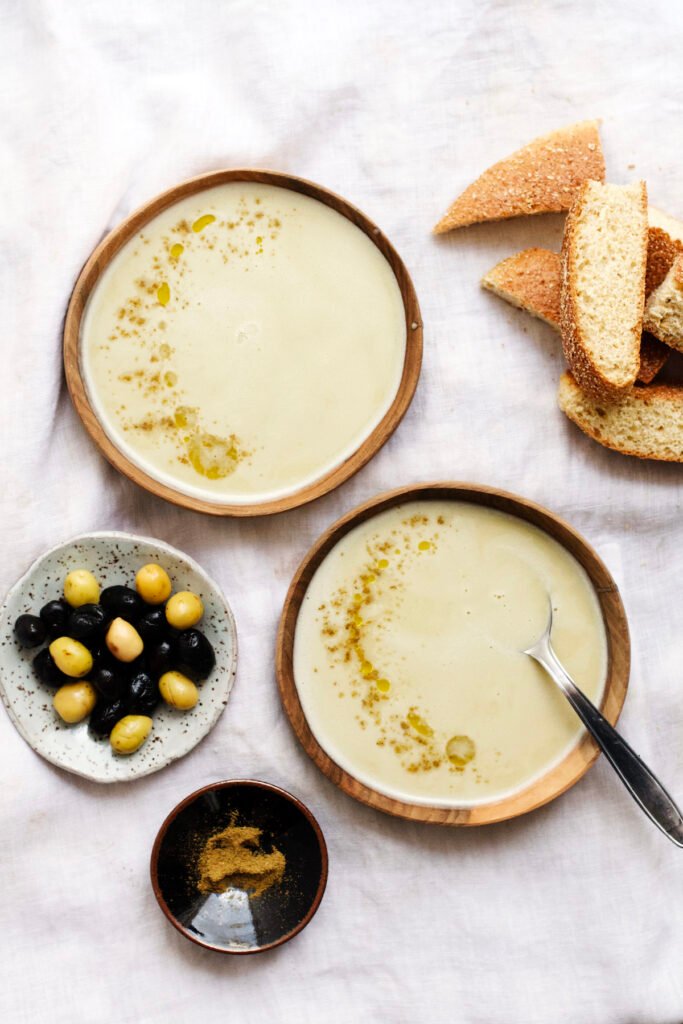

Walk past any working-class neighborhood in Morocco on a cold morning and you’ll smell it before you see it: garlic simmering in olive oil, cumin hanging in the damp air. Follow the smell to a hole-in-the-wall with a row of steaming pots, and you’ll find Moroccans gathered around small bowls of something thick, pale green, and entirely unpretentious. That is bissara (بصارة, sometimes spelled bessara) — Morocco’s humblest soup, and one of its most satisfying.
This is not the Morocco of rooftop restaurant menus. Bissara belongs to the street: to dawn breakfasts before a shift starts, to gargotes where the cook never measures anything, to winter mornings when a bowl of something hot costs next to nothing. If you want to understand how Moroccans actually eat — not how hotels serve them — bissara is where you start.
What bissara actually is
At its core, bissara is embarrassingly simple: dried split fava beans (in Moroccan Arabic, ful) simmered for a long time with water, crushed garlic, and olive oil, then mashed or blended until smooth. Once it hits the bowl, it gets the treatment that transforms it: a generous drizzle of extra-virgin olive oil, a dusting of ground cumin, a pinch of paprika, and — if you want heat — cayenne or a spoon of harissa. A squeeze of lemon juice is a common finishing touch.
There is no cream, no butter, no stock. The creaminess comes from the beans themselves. When dried fava beans cook down and are puréed, their starch turns the liquid into something velvety — closer to a thick split-pea soup than to anything you’d eat with a straw. Street versions tend to be cooked down thick, almost scoopable; home versions are often thinned to a proper soup.
Some cooks split the base: dried split peas (jelbana) instead of fava beans, sometimes mixed with them. The pea version is a touch sweeter and paler. Purists argue endlessly about which is the “real” bissara, and the north — Fez, Tetouan, the Rif — claims to make it best.
Food historians trace the dish’s lineage to ancient Egypt — a cousin of ful medames, Egypt’s slow-cooked fava bean dish. However it arrived in Morocco, it adapted to the Moroccan spice shelf and the Moroccan breakfast table, and it never left.
The taste catches travelers off guard. Bissara is nutty, earthy, and deeply savory from the beans, warmed up by cumin and lifted by the fruity bite of good olive oil. It is not spicy by default — the heat comes from what you add at the table, not what the cook puts in the pot. If you only try it once, eat it slowly. The flavor builds as the bowl cools.

Where and when to find it
Bissara is a morning and winter dish. Street stalls and gargotes start ladling it early — many open around sunrise — and it is firmly a breakfast food, though you’ll find it at lunch in the colder months. In summer, it largely disappears from menus; Moroccan cooks treat it as a cool-weather soup, and the first cold snap of the season is the unofficial signal for bissara to return.
Look for it where working people eat:
- Gargotes — workers’ canteens in medinas and industrial districts. A row of pots on a counter, plastic tables or none, regulars who don’t need a menu. Bissara is usually alongside harira, loubia, and tagine.
- Souk stalls — in food markets and around souks, vendors ladle it into bowls or cups for shoppers and porters.
- Neighborhood breakfast counters — in cities like Fez and Tetouan, some breakfast spots specialize in bean soups and serve bissara next to msemen and khobz.
You will rarely find bissara in mid-range or upscale restaurants, and almost never in hotels. That is not a quality judgment — it is the nature of the dish. It is priced for the street and eaten on the street. Expect to pay a few dirhams for a bowl; it is one of the cheapest complete breakfasts in the country.
📸 If you want to capture it, this is the shot: the stall’s row of pots at sunrise, steam in the cold air. Your own bowl mid-meal tells the story better than any posed restaurant dish.
How to eat it like a local
Bissara has a technique, and getting it right is half the experience. Locals do not approach it the way tourists approach soup. Here is the sequence:
- Claim your garnishes. On the counter or table you’ll usually find olive oil, ground cumin, paprika, and chili (or harissa). A street bowl may arrive already garnished; a home or gargote bowl expects you to finish it. Either way, do not eat it plain — the garnishes are not decoration.
- The olive-oil swirl. Pour a generous ring of olive oil over the top — not a timid drizzle, a proper swirl. The oil sits on the hot purée and perfumes every spoonful. This is the soul of the dish.
- Dust the cumin. A heavy pinch of ground cumin, sometimes mixed with a little paprika. Street eaters are generous with it. If there’s harissa and you like heat, stir a dab in now.
- Break the khobz. The round Moroccan flatbread arrives warm. Tear a piece, fold it into a scoop, and use it to lift the bissara. Khobz is your spoon. You can use a spoon too — nobody minds — but the bread scoop is how it’s traditionally eaten, especially when the bissara is thick.
- Add lemon last. If lemon wedges are on the table, squeeze one over your portion. The acidity cuts through the beans’ richness. Don’t add it before tasting — you want to know the base flavor first.
Etiquette is simple: eat at the counter, don’t rush, and don’t order bissara as a “starter” to impress anyone — it is a working meal, treated as such. If the stall also offers msemen (flaky flatbread), a side of it with bissara is a serious upgrade.
Bissara vs. harira vs. loubia: don’t mix them up
Tourists often lump all Moroccan soups into one bowl. The three bean-and-tomato soups of the Moroccan street are distinct, and ordering the right one matters:
- Bissara: pale green-cream purée of fava beans or split peas. Thick, no tomatoes, seasoned with cumin and paprika. Breakfast dish, winter staple. Eaten with bread as a scoop.
- Harira: the famous tomato-based soup with chickpeas, lentils, and vermicelli, tinted red-orange. Thinner than bissara, richer in tomato and herbs (parsley, cilantro, celery). Traditionally served to break the fast during Ramadan, but eaten year-round. Garnished with a squeeze of lemon.
- Loubia: white beans stewed in a tomato sauce with garlic, cumin, paprika, and often olives — closer to a stew than a soup. Heartier, chunkier, eaten with bread for mopping.
The quick rule: bissara is a smooth green-cream purée, harira is a tomato soup with chickpeas, loubia is a chunky white-bean stew. If you can’t tell them apart at the stall, ask — cooks are used to it, and most will happily ladle you a taste.

Common mistakes tourists make
1. Expecting it at dinner. Bissara is a morning dish. Many stalls sell out by mid-morning and don’t make more. If you show up at 8 p.m. looking for bissara, you’ll get harira — which is fine, but it’s not what you came for. Go before 10 a.m.
2. Eating it unseasoned. The base is deliberately plain — the flavor lives in the olive oil, cumin, paprika, and chili you add at the table. A bowl eaten straight from the pot, unadorned, is a pale version of itself. Garnish aggressively.
3. Paying tourist-menu prices. Bissara is one of the cheapest dishes in Morocco. If a menu in a tourist-heavy square lists it at restaurant prices, you’re in the wrong place. The real thing costs a few dirhams at a gargote. Don’t haggle — the price is already low — but don’t let a pretty menu convince you it’s a luxury dish.
4. Confusing it with soup back home. Travelers who expect a clear broth sometimes find bissara’s thickness surprising. It’s a purée, not a bouillon. Give it three bites before deciding.
5. Skipping the north. You can find bissara everywhere, but the north takes it most seriously. If your itinerary passes through Fez or Tetouan in winter, make a point of eating it there.
Frequently asked questions
Is bissara vegetarian?
Yes. Traditional bissara is made from fava beans, water, garlic, olive oil, cumin, paprika, and salt — no meat, no stock. It is naturally vegan. (As with any street food, if you have strict dietary needs, it’s worth a quick check — cooking practices vary from stall to stall.)
What is the difference between bissara and harira?
Bissara is a thick purée of fava beans or split peas, pale in color, seasoned with cumin and paprika, and eaten mainly for breakfast. Harira is a tomato-based soup with chickpeas, lentils, and vermicelli, thinner and richer in herbs, traditionally served to break the Ramadan fast. They are completely different dishes.
How much does a bowl of bissara cost?
Bissara is street food at its most affordable — a bowl costs a few dirhams at a gargote or market stall. It is one of the cheapest breakfasts in Morocco.
Can I eat bissara with a spoon?
Of course — but try the local way at least once: tear the khobz and use it as a scoop. When the bissara is cooked thick, bread is genuinely the better tool, and it’s how generations of Moroccans have eaten it.
Is bissara safe to eat at street stalls?
Bissara is served boiling hot, straight from the pot — which is exactly what you want from street food. Pick stalls with a steady flow of local customers, watch your bowl being ladled from the pot, and eat where the turnover is high. Hot, fresh, and busy is the formula.
If you want the full picture of eating on the street — the stall types, the etiquette, the hygiene reality — start with our Moroccan street food guide, then read our guide to msemen and baghrir, the flatbreads you will be scooping your bissara with. For a sense of what everyday meals cost, see food prices in Morocco in 2026.

Photo credits: “Bissara (Moroccan Dip)” by Miansari66 (CC0), via Wikimedia Commons — source; “Bissara, Moroccan split pea and fava bean soup” by Ruby Josephine Smith (CC BY-SA 4.0), via Wikimedia Commons — source; “Cumin” (whole and ground cumin seeds) by KVDP (public domain), via Wikimedia Commons — source; “Khobz Tajine” (Moroccan bread) by Meriemou (CC BY-SA 4.0), via Wikimedia Commons — source. All images verified from Wikimedia Commons, October 2026.
Recipe: Bissara, Fava Bean Soup (Home Adaptation)
Bissara is Morocco’s humblest soup and one of its smartest: no stock, no cream, no butter — dried fava beans simmered with garlic and olive oil until their own starch turns the pot silky. Split dried fava beans cook faster than whole ones and need no overnight soak, which makes this a genuine weeknight soup.
Ingredients (serves 6)
- 500 g dried split fava beans, rinsed
- 1.5 litres of water, plus more if needed
- 6 garlic cloves, crushed
- 100 ml olive oil, plus extra for serving
- 2 teaspoons ground cumin
- 1 teaspoon sweet paprika
- Salt to taste
- To serve: extra-virgin olive oil, ground cumin, paprika, cayenne pepper or harissa, lemon wedges, and warm crusty bread (khobz)
Preparation
- Put the rinsed beans in a large pot with the water and bring to a boil. Skim off the foam that rises, then add the crushed garlic.
- Lower the heat and simmer, partially covered, for 45–60 minutes, stirring occasionally, until the beans collapse completely when pressed with a spoon. Add a splash of hot water if the pot gets too thick before the beans are done.
- Blend the soup until completely smooth — an immersion blender works best. If it is thicker than a pourable soup, thin it with hot water, a little at a time.
- Stir in the olive oil, cumin, paprika and salt. Taste: it should be earthy, garlicky and well salted, with the cumin clearly present.
- Ladle into deep bowls and finish at the table: a generous swirl of olive oil, a dusting of cumin and paprika, and cayenne or harissa for those who want heat. Serve with bread for scooping and lemon wedges for squeezing.
Tip: bissara thickens fast as it cools. Serve it the moment it leaves the pot — or keep it loose with a ladle of hot water stirred in just before serving.