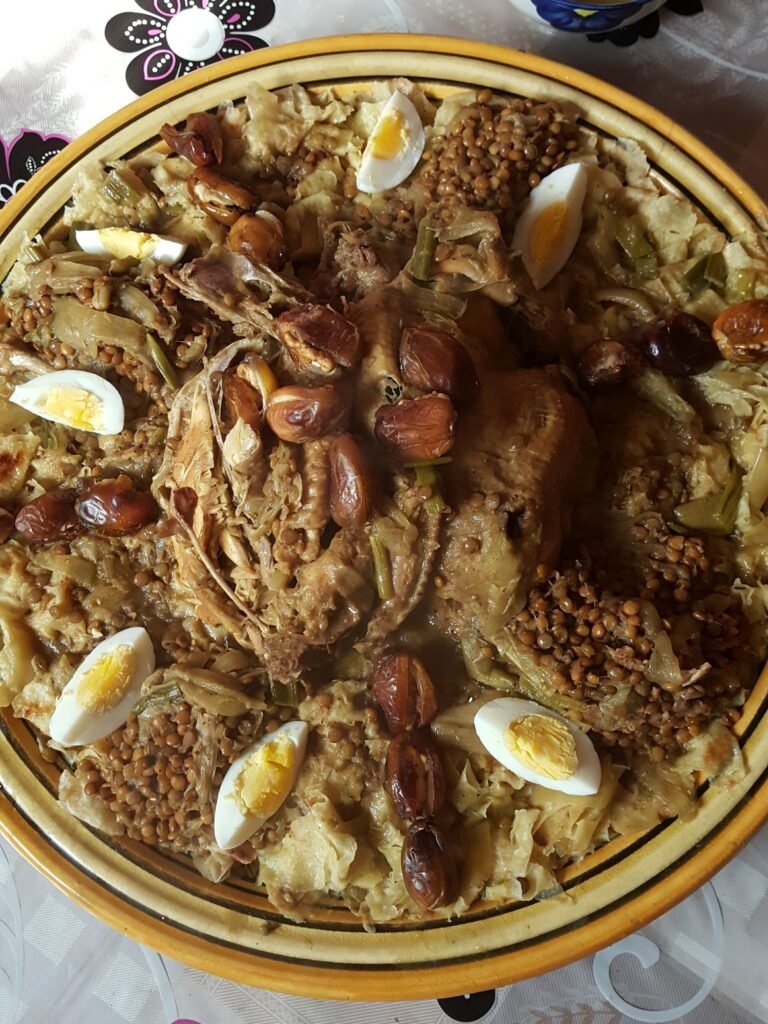
Ask a Moroccan family what they cook when someone they love needs strength, and many will answer with a single word: rfissa. This is not the dish tourists photograph in Marrakech restaurants. It is the dish Moroccan mothers make for their daughters after childbirth, the one that appears at weddings and family feasts, served from one enormous shared platter. Shredded flatbread soaked in golden, saffron-scented chicken broth, topped with tender chicken, soft lentils, and the bitter-sweet note of fenugreek — rfissa is Morocco’s great comfort dish, and it stays almost invisible to visitors who only eat out.

What Is Rfissa?
Rfissa belongs to the ancient family of tharid dishes — bread soaked in broth. Tharid is one of the oldest dishes of the Arab world, said to have been the Prophet Muhammad’s favorite meal, and rfissa is its Moroccan descendant. The name goes back to the medieval rafis, a dough kneaded with butter and dusted with sugar — the idea of tearing bread into a rich sauce is centuries old.
The structure never changes: a base of shredded flatbread, chicken slow-stewed with onions, lentils, and fenugreek seeds, and a generous spiced broth poured over everything just before serving. It arrives in a gassaa, the wide communal serving dish, and everyone eats from it together.
A detail that says a lot: rfissa did not appear in a single Moroccan cookbook until the 1990s. The cultural historian Anny Gaul has pointed out why — rfissa grew out of rural traditions, while for generations Morocco’s cookbook authors were mostly the urban elites of Fès. This is home cooking in the truest sense, passed from mother to daughter rather than chef to cookbook, which is exactly why it tastes like nothing on a tourist menu.
The Key Ingredients
A proper rfissa has five non-negotiable elements. Miss one, and Moroccans will tell you it is something else.
1. The chicken

Traditionally a whole chicken, cut into pieces, marinated for hours — ideally overnight — in saffron, ground ginger, turmeric, black pepper, garlic, and olive oil, sometimes with a spoonful of smen (Moroccan preserved butter). It simmers with sliced onions until the meat nearly falls off the bone. Some families finish it under a hot grill so the skin turns golden before it goes on the platter. The broth it cooked in becomes the soul of the dish.
2. The lentils

Green or brown lentils, soaked for about 30 minutes, cook directly in the chicken broth with the onions and fenugreek. They absorb the saffron and spice flavors and give the dish its hearty character. The sauce should be thick enough to cling to the shredded bread but still generous — a dry rfissa is a failed rfissa, because the bread base drinks up a surprising amount of liquid.
3. Fenugreek — the helba

Fenugreek seeds, called helba in Morocco, are rfissa’s signature. No other Moroccan dish uses them in this quantity, and their slightly bitter, maple-like aroma makes rfissa instantly recognizable. They must be soaked overnight — the most important preparation step. Unsoaked fenugreek turns the broth harshly bitter, and experienced cooks taste the mistake immediately. Some cooks tie the soaked seeds in a cloth pouch so they flavor the broth but can be lifted out before serving.
4. The bread base: msemen or trid

The base is shredded flatbread, and here families divide. The classic version uses trid: very thin, crepe-like sheets of dough cooked on a hot griddle, then torn into pieces. Making trid is skilled, slow work — the dough must be stretched paper-thin by hand. The modern shortcut is msemen: the square, folded, pan-fried flatbread, torn into strips. Msemen gives a slightly richer, chewier base; trid gives a lighter one that melts faster into the broth. Some families use meloui or even day-old bread. Our full guide to these flatbreads is here: Msemen & Baghrir: Morocco’s Beloved Flatbreads Explained.

5. The spice blend
Beyond saffron, ginger, and turmeric, rfissa is seasoned with ras el hanout, plus cinnamon, black pepper, fresh parsley and cilantro, and smen. The flavor is warm and aromatic, never fiery: there is no chili heat in a traditional rfissa. Saffron gives the broth its golden color; cinnamon and ras el hanout give it depth; fenugreek gives it that unmistakable edge.
Variations Across Morocco
Rfissa is not one fixed recipe — it shifts by region, by city, and by family, and knowing the differences helps you understand what lands on your plate.
Trid vs. msemen: the great divide
The most meaningful variation is the bread. A rfissa made with handmade trid is the old, labor-intensive version — the sheets are cooked, stacked, torn by hand, and layered in the gassaa. A rfissa made with shredded msemen is the everyday version most Moroccans actually eat today, and shredded msemen is sold ready-made in many local markets. Neither is “wrong”; they are two eras of the same dish.
Casablanca and Rabat: the dish’s stronghold
Today rfissa is most closely associated with the Atlantic coast, especially the Casablanca and Rabat regions, where it is a fixture of family celebrations. Its roots run older and more rural — remember that it comes from countryside traditions rather than the refined Fassi kitchen of the old cookbooks — but the coastal cities are where the dish is most visibly alive now, made for births, weddings, and big family tables.
The frugal version and the festive version
At its simplest, rfissa can be made with day-old bread instead of fresh flatbread — the broth does all the work, and nothing is wasted. At its most festive, the platter is garnished with hard-boiled eggs, dates, dried apricots, or walnuts over the chicken — the version you see at celebrations, where the dish has to look as generous as it tastes.
When Moroccans Eat Rfissa
Timing is part of the dish’s identity. Rfissa is celebration and care food, not everyday food:
- After childbirth: the most famous occasion. Moroccan families traditionally prepare rfissa for a woman who has just given birth — it is the dish of the postpartum table, made to nourish and comfort the new mother.
- Weddings and births: large platters of rfissa feed the extended family gathered for happy events.
- Religious celebrations: it appears on festive tables during religious holidays.
- Mid-Ramadan: some families serve trid-based rfissa to mark the end of the first half of Ramadan.
- Family gatherings: any occasion when the whole family is under one roof is a good enough reason.
Notice what is missing from that list: the restaurant. Rfissa is overwhelmingly a home dish, which brings us to the practical part.
How to Eat and Order Rfissa as a Traveler
Here is the honest truth: you will rarely find rfissa on a restaurant menu in Morocco. Travel writers who spent weeks eating across the country report spotting it on a menu only once or twice — it is simply not a restaurant dish. It takes hours to prepare, the fenugreek must be soaked the night before, and it is designed to be eaten communally, not plated for one.
The reliable path is through your accommodation. Many riads and guesthouses will prepare rfissa if you ask a day in advance — that lead time matters, because of the overnight soaking and marinating. Ask when you book, or at breakfast the day before. Some cooking classes and food tours in Fès, Rabat, and Casablanca also include it, since it is a showpiece of home cooking.
At the table, rfissa is served in the middle in its big platter, and everyone eats from it together. Take shredded bread with broth, some chicken, and lentils. The proper texture is thoroughly soaked — the bread should be saturated with broth. If you are offered the festive version with dates or boiled eggs, try them: the sweetness of the dates against the bitter-sweet fenugreek broth is one of the dish’s best contrasts.
About prices: since rfissa is a home dish, there are no standard menu prices to quote. If a guesthouse prepares it, it is usually part of a set dinner or a special request — ask upfront. For a sense of what dinners typically cost, see our 2026 food price guide.
[📸 Photo spot: the site owner can add his own photo here — for example a rfissa served at a Moroccan family table or a riad.]
Common Mistakes (and How to Avoid Them)
- Skipping the fenugreek soak: unsoaked helba makes the broth bitter and harsh. Soak the seeds overnight, no exceptions.
- Too little broth: the shredded bread absorbs an enormous amount of liquid. The sauce should look almost too generous in the pot.
- Overcooking the chicken in the broth: if the chicken falls apart before serving, lift it out once tender and add it back at the end.
- Confusing it with tagine: rfissa is not a tagine — the bread base is the point of the dish, not a side. For the real tagine experience, see our complete tagine guide.
Frequently Asked Questions
What does rfissa taste like?
Warm, savory, and deeply aromatic: saffron-golden chicken broth, soft lentils, tender chicken, and the distinctive bitter-sweet note of fenugreek, all soaked into soft shredded flatbread. It is rich but not heavy, spiced but not hot.
Is rfissa spicy?
No. Traditional rfissa contains no chili heat. Its warmth comes from ginger, black pepper, cinnamon, and ras el hanout — aromatic spices, not fiery ones.
Why is rfissa served to new mothers?
It is a long-standing Moroccan tradition: families prepare rfissa for a woman who has just given birth, as nourishing comfort food for the postpartum period. The dish’s association with care and recovery is cultural — it is the meal Moroccan families make when someone needs strength.
Can vegetarians eat rfissa?
Not in its traditional form — the dish is built around chicken and its broth. The lentil, onion, and fenugreek base is flavorful on its own, so a meat-free version is conceivable, but you would need to request it specially.
Where can I try rfissa in Morocco?
Almost never in restaurants — it is a home dish. Your best chances: ask your riad or guesthouse at least a day ahead, join a Moroccan cooking class, or book a food tour that visits a family kitchen. The Casablanca and Rabat regions are the dish’s modern stronghold.
Photo credits: Rfissa dish photo by Solima arizo (CC BY-SA 4.0, via Wikimedia Commons); msemen photos by Tililen84 / Hadni S and Mounir Neddi (CC BY-SA 4.0, via Wikimedia Commons); lentils photo by HaJunkiyada (CC BY-SA 4.0, via Wikimedia Commons); chicken photo by Jameswasswa (CC BY-SA 4.0, via Wikimedia Commons); fenugreek seeds photo by Atudu (CC BY-SA 4.0, via Wikimedia Commons). All photos are real, freely licensed — no AI images. Published by FoodMaroc.
Recipe: Rfissa with Chicken, Lentils and Fenugreek (Home Adaptation)
Rfissa belongs to the tharid family — bread soaked in broth — and the home cook’s best friend here is msemen, the square flatbread. Shredded fresh into the serving platter and flooded with hot saffron broth, it drinks up the sauce without turning to mush. The one ingredient that needs respect is fenugreek: a quick dry toast tames its bitterness into something warm and almost sweet.
Ingredients (serves 6)
- 1 whole chicken (about 1.5 kg), cut into pieces — or 6 chicken thighs
- 250 g brown lentils, rinsed
- 2 tablespoons fenugreek seeds
- 3 large onions, finely sliced
- 1 teaspoon ground turmeric
- 1 teaspoon ground ginger
- 1/2 teaspoon black pepper
- A good pinch of saffron threads (or 1/2 teaspoon extra turmeric)
- 100 ml olive oil
- 1 tablespoon smen (fermented butter) or 50 g butter
- Salt to taste
- 6 msemen (Moroccan square flatbreads), torn into bite-size pieces
- About 1.5 litres of water
Preparation
- Toast the fenugreek seeds in a dry pot for 1–2 minutes until fragrant, then set aside. Brown the chicken pieces in the olive oil until golden on all sides.
- Add the sliced onions, turmeric, ginger, black pepper, saffron and salt. Stir for 5 minutes until the onions soften and coat the chicken.
- Add the lentils, the toasted fenugreek seeds and the water. Bring to a boil, then lower the heat and simmer, partially covered, for 45–60 minutes, until the chicken is falling off the bone and the lentils are completely soft.
- Lift out the chicken pieces and stir the smen (or butter) into the broth. Taste and adjust the salt — the broth should be deeply savoury.
- Spread the torn msemen in a wide, deep serving platter. Ladle the hot broth over the bread until it is well soaked, then arrange the chicken pieces and spoon the lentils over the top. Finish with one more ladle of broth, poured over everything just before bringing it to the table.
Tip: assemble at the last minute. Msemen keeps its bite for about ten minutes in hot broth — after that it collapses. Keep extra broth warm on the stove so everyone can add more at the table.