Pastilla (Bastilla): Where Sweet Meets Savory — Morocco’s Most Surprising Pie
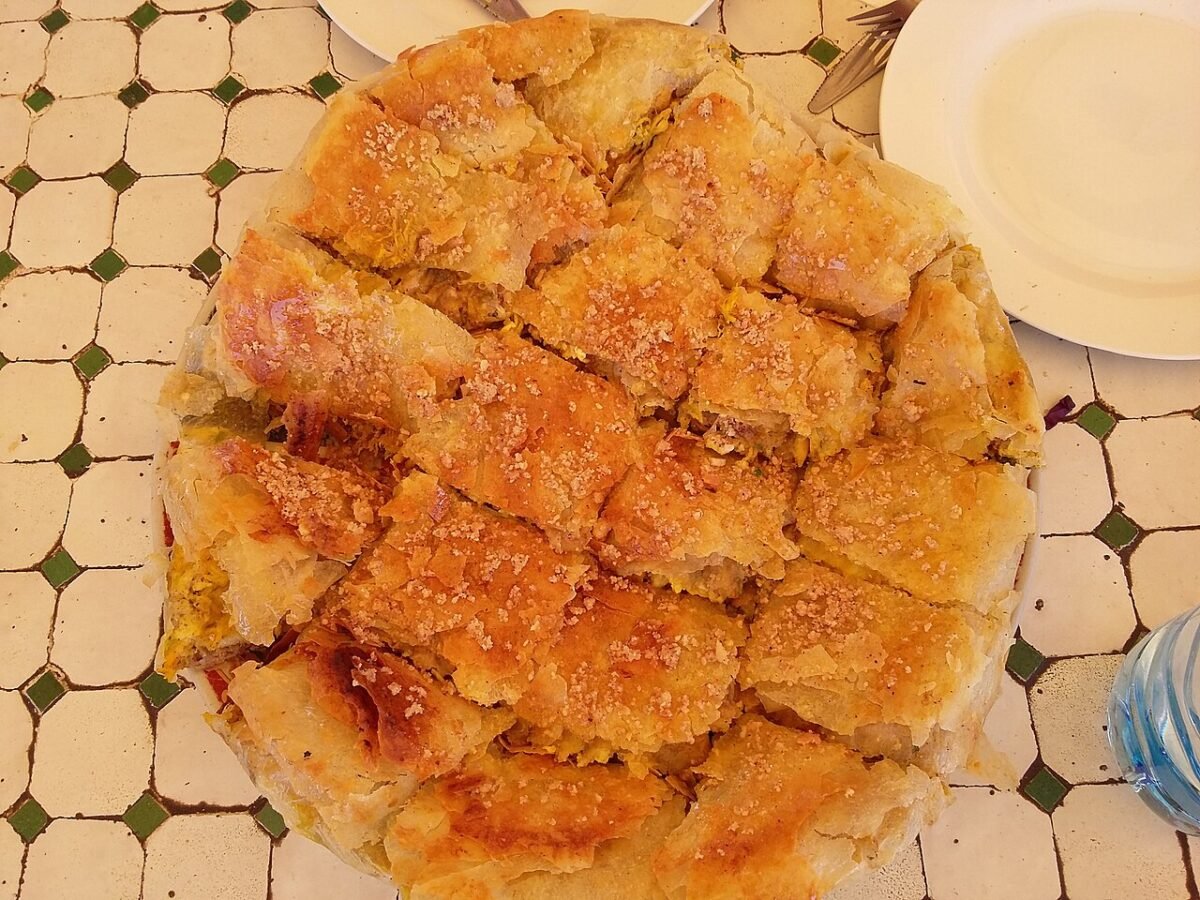
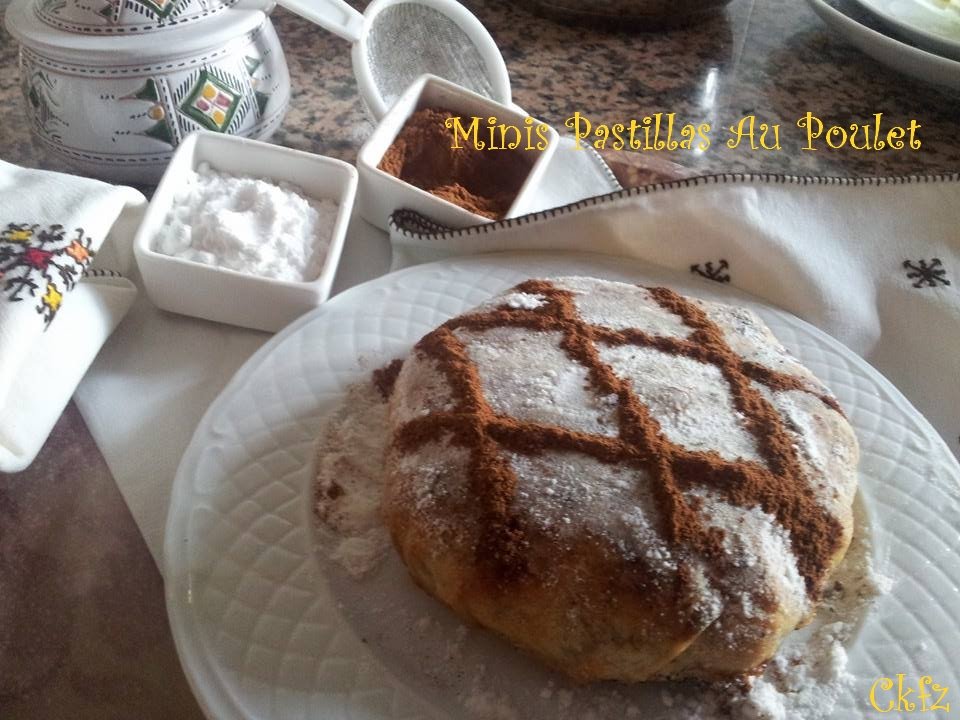
No dish ambushes a first-time visitor to Morocco quite like the pastilla. It arrives at the table looking exactly like a dessert: a golden, perfectly round pie, dusted with powdered sugar, cinnamon traced across the top in a careful lattice. You cut in, the steam rises, and suddenly the air smells of saffron, ginger, and slow-cooked chicken. Your brain stalls. It is not dessert. It is not quite dinner either. It is both at once — and every part of that contradiction is deliberate.
Pronounced “bas-TEE-ya” — most Moroccans turn the Spanish p into a b, which is why you will see it spelled bastilla, bastila, or bisteeya on menus — this is the dish the imperial city of Fès guards most jealously. It is wedding food and feast food, the course that tells the guests the hosts spared no effort. Here, sweet and savory are not opposites. They are partners.
What sits inside the pie
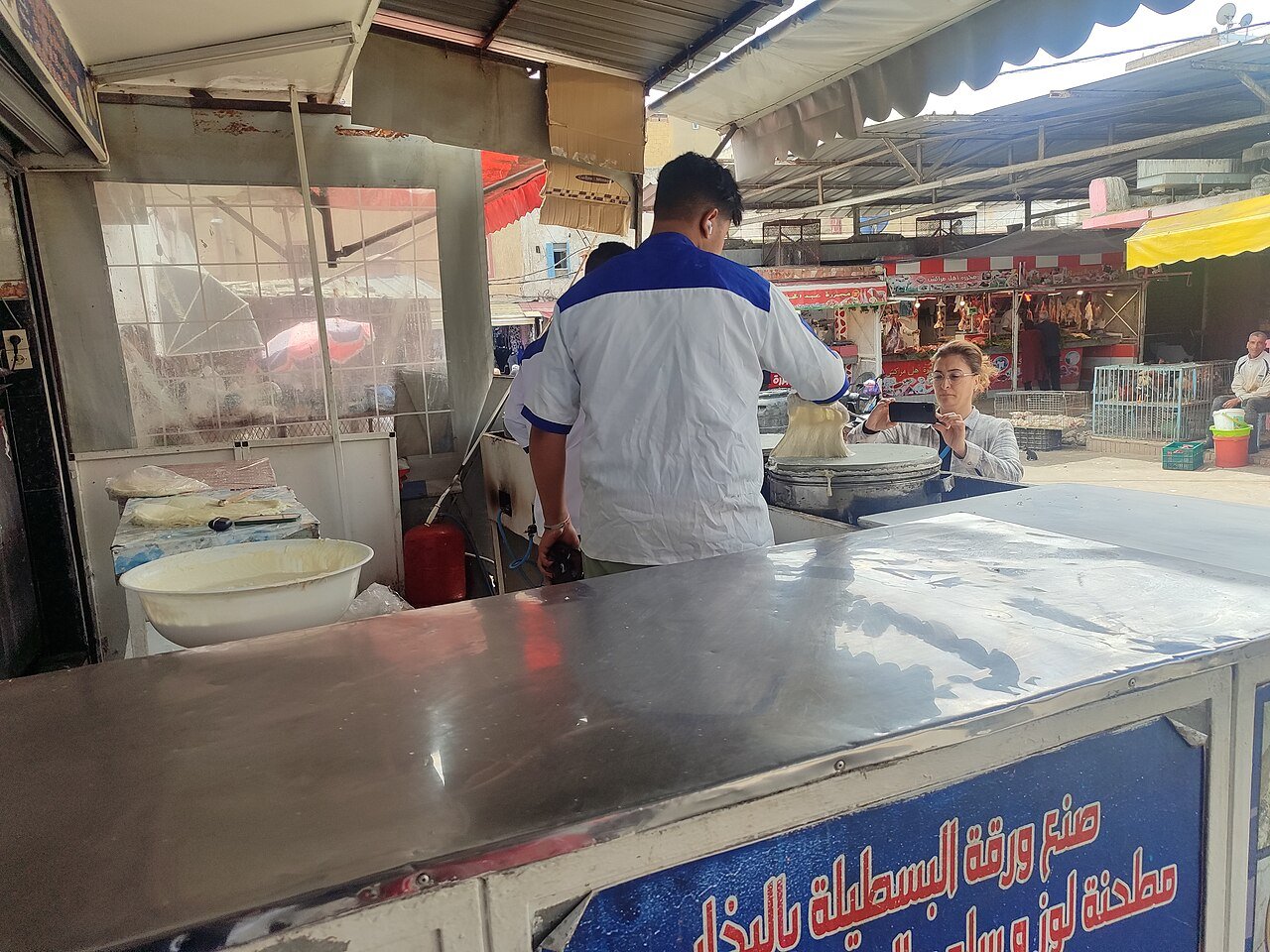
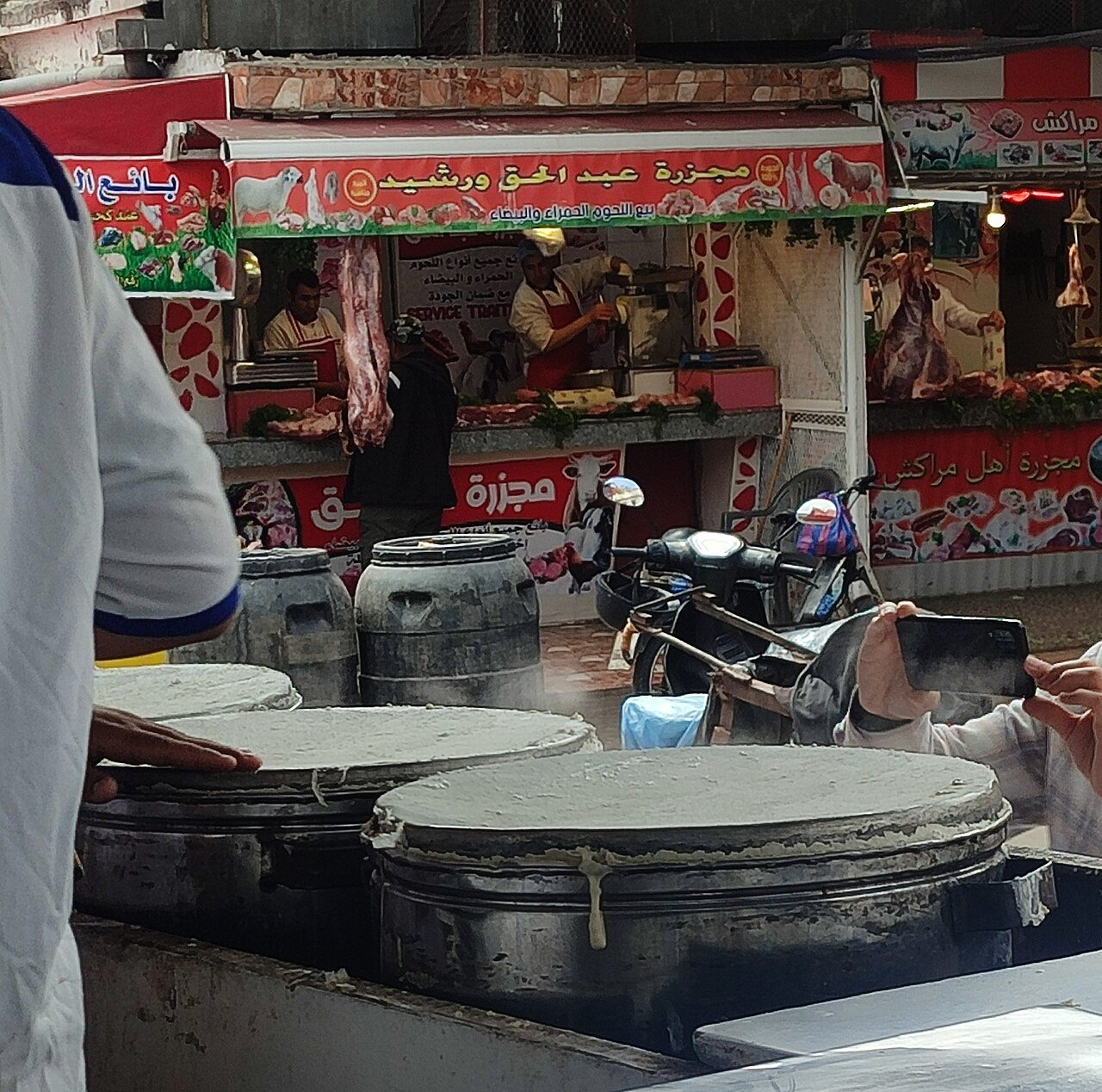
The shell is warka (also spelled werqa), a pastry so thin it is translucent before it goes into the oven. It bears no real resemblance to supermarket phyllo. Real warka is brushed, sheet by sheet, onto an inverted hot griddle by hand — and in the Fès medina, specialists still make it fresh every morning and sell stacks of it to pastry stalls and restaurants. Buy it a day old and the pastilla will not crisp the same way; cooks know this and plan around it.
The filling starts with poultry — chicken in most of Morocco, pigeon in the classic Fès version — slow-poached with sliced onions, saffron, ginger, cinnamon, coriander, and parsley. The meat is lifted out and shredded; the cooking liquid is reduced, then beaten eggs are stirred in until the sauce thickens. The shredded meat goes back in. Between and above this goes the second layer: fried almonds, ground with sugar and plenty of cinnamon.
The warka sheets are layered, filled, folded into a round parcel, and baked until deeply golden. Just before serving, the top is dusted with powdered sugar and cinnamon, often in the lattice pattern that has become the dish’s signature. Eat a forkful and the sequence hits in order: the shattering crisp of the pastry, the warm spice of the chicken, the crunch and perfume of the almonds, then the sugar and cinnamon rounding it all off. None of it is accidental.
Five centuries inside one pie
The word itself gives away the first chapter. Pastilla comes from the Spanish for “small pastry,” and the p-to-b shift is routine in Moroccan Arabic. Food historian Anny Gaul has traced recipes resembling the modern bastila stuffing to 13th-century Andalusi cookbooks — including Ibn Razin al-Tujibi’s famous manual — where pigeon is cooked with cinnamon, almonds, saffron, onion, and eggs, using the same double-cooking method pastilla still uses today: first in the pot, then finished in the oven.
The likeliest story is that Andalusi refugees carried an early version across the Strait of Gibraltar — Muslims leaving al-Andalus brought their cooking with them in waves from the 9th century onward, and Fès, whose Andalusi quarter was settled by exiles from Córdoba, became its stronghold. The history is not entirely settled: some historians argue the ultra-thin warka wrapping arrived later, possibly through Ottoman-Algerian culinary influence reaching Tetouan in the 19th century. What is certain is that the seasoned pigeon-and-almond heart of the dish is Andalusi, and Fès spent centuries turning it into an art form.
📸 [The site owner can add a personal photo here: a pastilla served at a Fassi table, or the warka vendor’s griddle in the medina.]
The four pastillas of Morocco
Ask for “pastilla” in different cities and you will get different pies. Knowing which is which saves you from disappointment — and from ordering the wrong thing for the wrong moment.
1. Bastila bil-djaj — chicken pastilla
The version most travelers meet. Chicken is cheaper and easier than pigeon, and a well-made chicken pastilla is genuinely excellent. This is the default on restaurant menus; if a menu simply says “pastilla,” this is what will arrive.
2. Bastila bil-hamam — pigeon pastilla
The Fès original and the connoisseur’s choice. Squab (young pigeon) gives a deeper, slightly gamey flavor that stands up to the cinnamon and almonds in a way chicken sometimes cannot. This is the pastilla of weddings and old Fassi families, and it is the one worth traveling for. One practical note: because pigeons are prepared to order, traditional restaurants in Fès commonly ask you to order the pigeon version a day ahead.
3. Bastila bil-hout — seafood pastilla
The north’s answer. In Tetouan, Tangier, and the coastal cities, the pie is filled with fish, shrimp, and calamari, often with thin vermicelli noodles folded in. The seasoning shifts too — more heat, more herbs — and the sugar dusting usually disappears. If the sweet-savory combination makes you nervous, the seafood version is the gentlest entry point.
4. Bastila bil-hlib — milk pastilla
Fès again, but at the other end of the meal. The dessert pastilla replaces the poultry with sweetened milk, thickened and perfumed with orange-blossom or rose water, layered with almonds inside warka. It is served at the end of a feast, not the beginning.
Where you will actually meet one
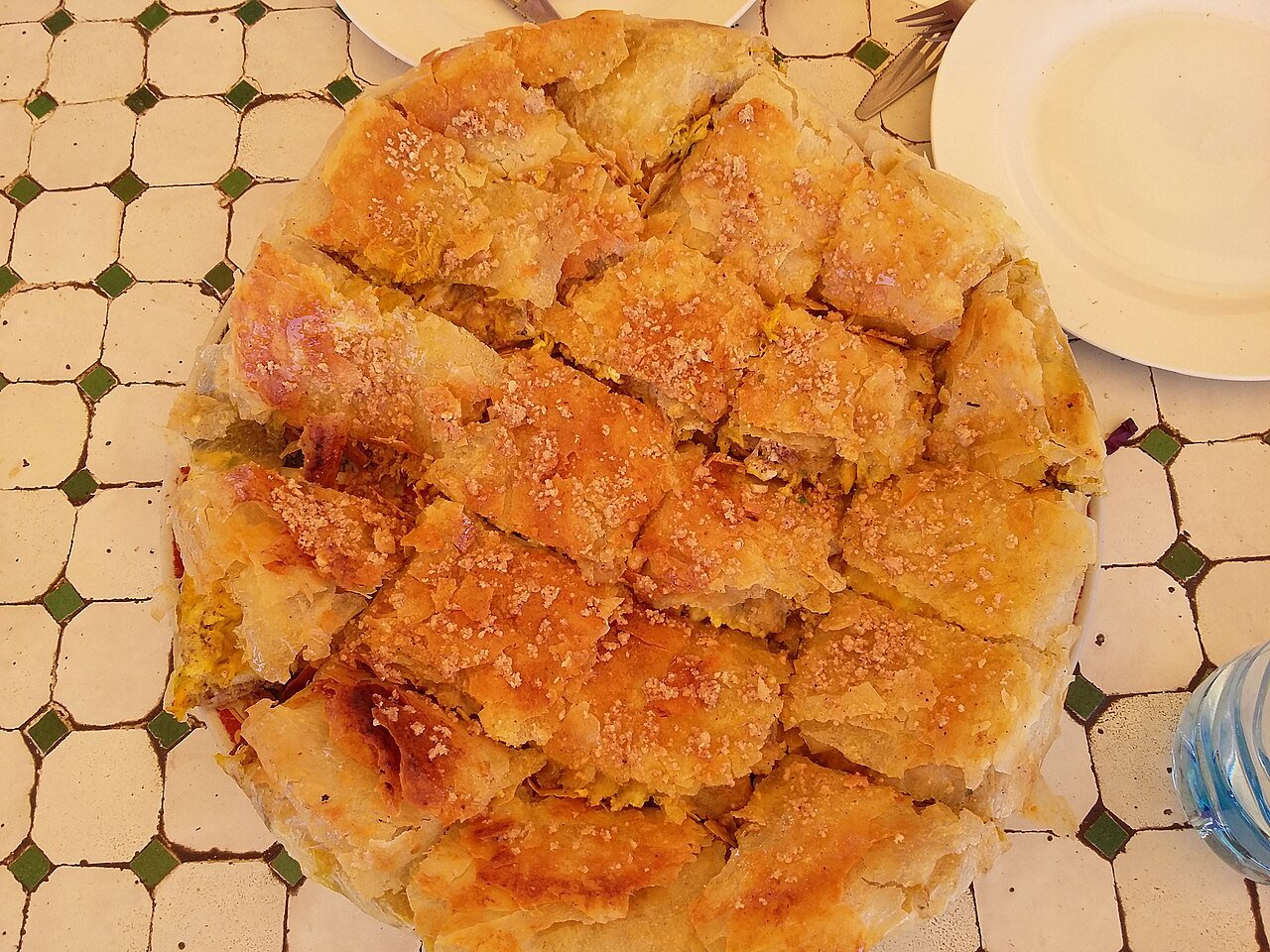
Fès is the capital of the pastilla, and there is no close second. Traditional Fassi restaurants serve it as a matter of identity; the medina’s warka stalls and pastry shops sell it whole, to take home for family meals. At weddings — the dish’s natural habitat — whole pastillas arrive early in the feast, sliced at the table like cakes, one pie shared between four to six guests.
Outside Fès, most restaurants that serve Moroccan classics will have a chicken pastilla on the menu, and many offer an individual size — a small personal pie that works as a light meal. In the north, ask for the seafood version by name. The pigeon pastilla remains a Fès specialty worth the detour; it is the dish the city measures itself by.
A useful parallel: the pastilla’s small triangle cousins, briouats, are sold at street stalls across the country — the same warka, folded around almond paste or spiced meat and fried. They are the street-food version of the same idea, and our Moroccan street food guide maps where to find the best of them.
How to eat it like it is meant to be eaten
A whole pastilla is shared food. It is sliced at the table like a cake, and four to six people take a wedge each as a starter. At a feast, it follows the cooked salads and comes before the tagine or couscous — it opens the meal rather than closing it. (For the full ceremony of a traditional Moroccan meal, see our tagine guide.)
Eating with your fingers is perfectly acceptable — the wedges are sturdy and easy to pick up — though a fork is the norm at more formal tables. A glass of mint tea alongside is the classic pairing; the tea’s sweetness and the pie’s spice lean into each other instead of clashing. And if you are dining alone, order the individual pastilla rather than attempting a whole one: the pie does not reheat into the same crisp thing.
If you are unsure how to order at a traditional restaurant — what to ask, when to ask for the pigeon version, how the courses are sequenced — our guide to ordering like a local in a Moroccan restaurant walks through the whole ritual.
Five mistakes visitors make
- Ordering a whole pastilla for one person. A full pie feeds four to six as a starter. Solo diners should ask for the individual size — every traditional restaurant that makes pastilla knows exactly what you mean.
- Treating it as dessert. Except for the milk version, pastilla is an early savory course at a feast. Ordering it after your tagine marks you as a tourist and confuses the kitchen’s sequencing.
- Assuming chicken is the original. Chicken is the common version; pigeon is the Fès classic. In Fès, asking for bastila bil-hamam — and ordering it a day ahead — is how you get the real thing.
- Only trying it in Marrakech. Marrakech makes a fine chicken pastilla, but the dish belongs to Fès, and the seafood version belongs to the northern coast. Eat each where it is from.
- Asking for it “without the sugar.” The powdered sugar and cinnamon on top are structural, not decorative — they are half of the sweet-savory design. If the combination worries you, order the seafood pastilla instead of asking the kitchen to dismantle the classic.
Frequently asked questions
Is pastilla sweet or savory?
Both, by design. The filling is savory — spiced poultry, onions, saffron — while the almond layer and the sugar-cinnamon dusting on top are sweet. The contrast is the entire point of the dish.
Chicken or pigeon — which should I try?
If you are in Fès, the pigeon pastilla (bastila bil-hamam) is the one to seek out — richer and more complex — but order it a day ahead, as traditional restaurants prepare it to order. Elsewhere, the chicken version is the standard and is excellent when the warka is fresh.
How do you pronounce it?
“Bas-TEE-ya.” The spelling “pastilla” reflects the Spanish root, but in Moroccan Arabic the p becomes a b. Saying “bastiya” will get you understood everywhere.
Is there a vegetarian pastilla?
Not traditionally — the classic is built around poultry. A few modern restaurants will prepare a vegetable version if you ask in advance, but always ask exactly what is inside before ordering; “pastilla” on a menu without qualification means the poultry version.
How big is a whole pastilla?
A full round pie serves four to six people as a shared starter. It is not a single serving, and it does not reheat well — the warka loses its crispness. Dining alone or as a couple, ask for the individual size.
Does the seafood pastilla have sugar on top?
Usually not. The northern seafood version is seasoned as a fully savory pie, often with vermicelli noodles in the filling. If you want to try pastilla but the sweet-savory combination sounds like too much, this is your version.
Photos: “Moroccan Pastilla” by Weetjesman, CC BY-SA 4.0, via Wikimedia Commons; “Pastilla au poulet et amandes” by Fatima zahra Charif Khalifi, CC BY-SA 4.0, via Wikimedia Commons; “Pastilla sheets from Souk Jmiaa in Casablanca” and “Pastilla from Souk Jmiaa in Casablanca” by Mounir Neddi, CC BY-SA 4.0, via Wikimedia Commons.